Transport to the islands
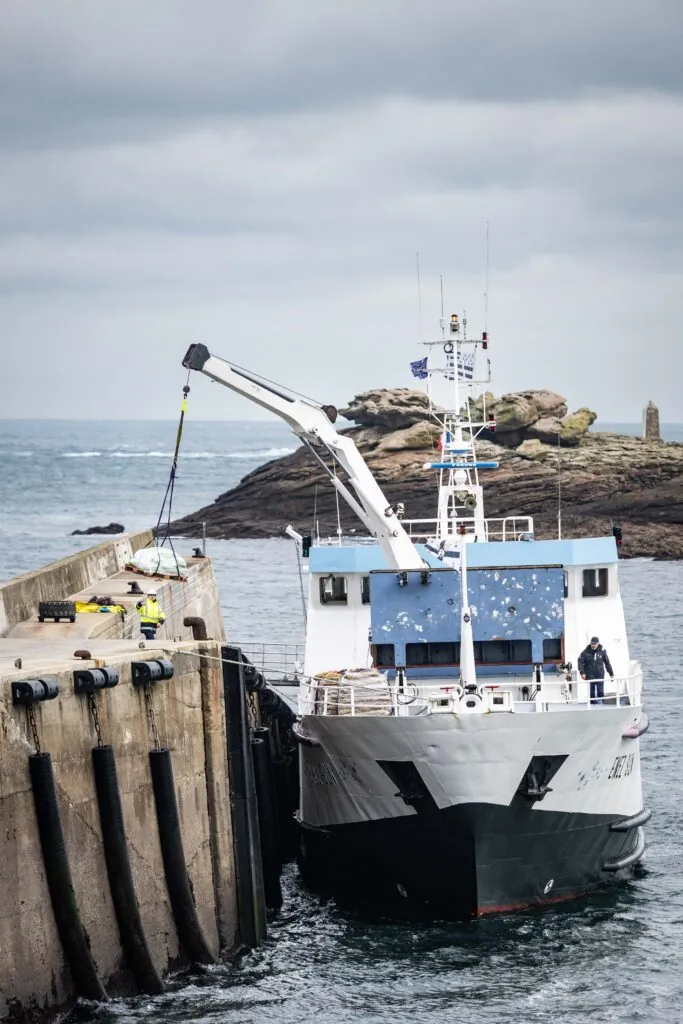
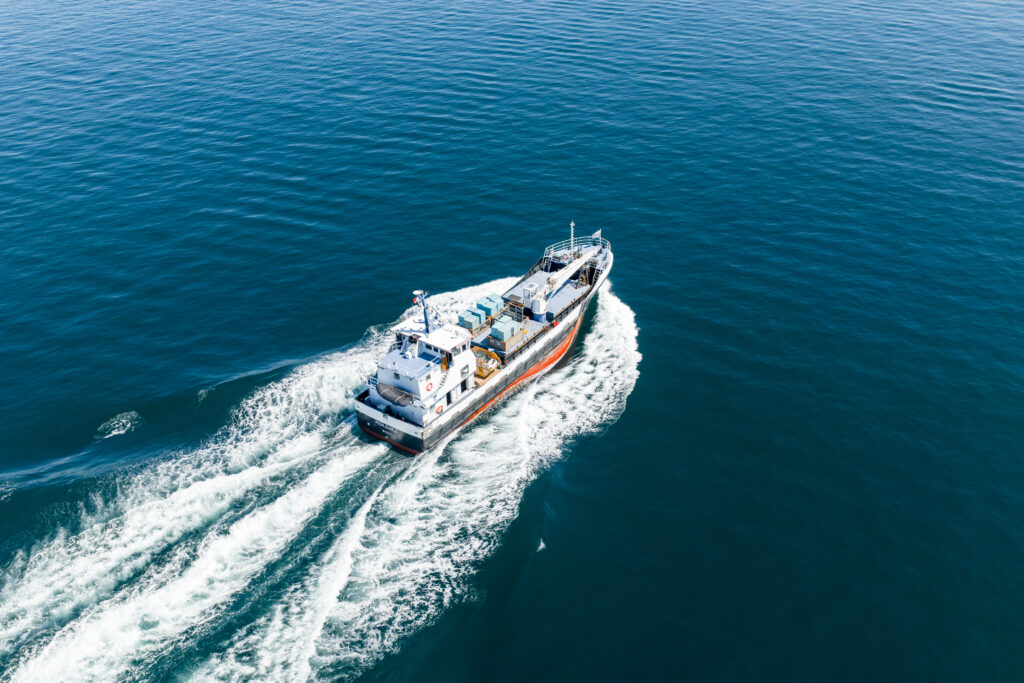
BreizhGo Penn Ar Bed is the only company providing freight transport between the mainland and the islands, primarily using the Molenez but also its other scheduled vessels such as the Fromveur II and the Enez Eussa III (North) as well as the Enez Sun III (South).
The BreizhGo Penn Ar Bed shipping company offers rates tailored to the type of goods being transported. These rates are divided into six categories: miscellaneous, materials, fresh and frozen goods, fragile items, vehicles, and other items. They are calculated based on the number of units, weight or volume of the goods.
Prices
To find out the cost of shipping your item, please consult our alphabetical index, which will show you the relevant price category.
Example: If you want to know the cost of shipping a microwave, look up ‘microwave’ in the index. You will find that it falls under the ‘fragile’ category.
If your microwave weighs 13 kg, the delivery charge will be €12.80 including VAT.
Goods are insured against the usual risks of transport. The carrier’s liability is governed by Articles L5422-12 to L5422-18 of the Transport Code and is limited to 666.67 SDRs per parcel, or 2 SDRs (equivalent to €1.25 as at 1 January 2025) per kilogramme of lost or damaged goods, whichever is the more favourable limit.
To ensure that the full value of your parcels is covered, the sender can take out insurance with the carrier before dispatch.
Freight transport varies from island to island; for further information, please see the sections below.
FREIGHT
Goods are transported in accordance with the provisions of the Transport Code. Goods are transported exclusively from Brest (to Molène and Ouessant) and from Audierne or Douarnenez (to the island of Sein). From Monday to Saturday, excluding Sundays and public holidays, and subject to the ships’ carrying capacity. Goods must be packed or packaged to protect them against the risks of sea transport. The packaging must be strong enough to withstand handling in port, pressure in the hold, the ship’s movements at sea, shifting of cargo, and the duration of the journey… Goods must be provided with appropriate labelling or marking. All goods must be registered at the port of departure
UNLABELLED PARCELS CANNOT BE LOADED INTO CONTAINERS OR SHIPPED.
Goods and hand luggage to be shipped on the same day must be delivered and checked in no later than 45 minutes before departure. There is no guarantee that parcels and luggage delivered less than 30 minutes before departure will be shipped on the same day. Pallets must allow for acceptable container filling (internal dimensions: H = 1.60 m, L = 1.90 m, W = 1.35 m). If this is not the case, each parcel may be unpacked for stowage in the container (depending on the vessel).
GENERAL CARGO
No goods may be delivered directly on board vessels. Goods must be received and registered at the ferry terminal during opening hours. The Company accepts no liability for any damage or loss suffered by goods left outside the warehouse’s opening hours. Charges are calculated by weight or volume in accordance with the Company’s rates. Port charges are payable either at departure or at destination.
GOODS STORED AT A CONTROLLED TEMPERATURE
Any fresh or frozen goods delivered at a temperature that does not comply with the requirements will be refused by the Company. Frozen goods must be delivered in insulated packaging capable of maintaining the required temperatures throughout the entire sea transport journey.
DANGEROUS GOODS
The following are considered hazardous in everyday products:
• flammable substances: petrol, white spirit, etc., and items containing them (engines, etc.)
• explosive materials:
• aerosols
• pressure capacity (oxygen, acetylene, butane, propane)
• pyrotechnics (fireworks, firecrackers) etc.
• acids
Goods consisting of flammable, explosive or dangerous materials, the carriage of which the carrier or its representative would not have consented to had they been aware of their nature, may at any time and in any place be unloaded, destroyed or rendered harmless by the carrier, without any compensation being payable. The shipper shall also be liable for any damage and expenses that may result from their loading. Such goods may not be carried on mixed-use vessels (passenger/cargo). We draw carriers’ attention to the danger of including such products in mixed pallets.
All dangerous goods falling within a hazard class must be booked in advance with the freight department (02 98 80 81 60 or [email protected]). A request for the delivery of dangerous goods must include the following details:
• Product safety data sheet
• Product name
• Packaging type (can, bag, drum, etc.)
• Quantity to be transported
• Number One
No goods will be stored on site. Deliveries that have not been authorised in advance will be refused.

All substances or articles, solutions or mixtures, preparations or wastes listed in the regulations are classified into thirteen hazard classes:
Class 9: Miscellaneous dangerous substances and articles
Class 1: Explosive substances and articles
Class 2: Gases
Class 3: Flammable liquids
Class 4.1: Flammable solids, self-reactive substances, polymerising substances and desensitised explosive solids
Class 4.2: Substances liable to spontaneous combustion
Class 4.3: Substances which, in contact with water, emit flammable gases
Class 5.1: Oxidising substances
Class 5.2: Organic peroxides
Class 6.1: Toxic substances
Class 6.2: Infectious substances
Class 7: Radioactive materials
Class 8: Corrosive substances
LIVE ANIMALS
The Company undertakes, when transporting live animals, to prioritise respect for animal welfare in accordance with REGULATION (EC) No 1/2005 OF THE COUNCIL of 22 December 2004 on the protection of animals during transport and related operations and amending Directives 64/432/EEC and 93/119/EC and Regulation (EC) No 1255/97. Please contact our freight department to discuss the arrangements for such transport.
DANGEROUS ITEMS
Weapons of any kind are considered dangerous items. Passengers in possession of such items are asked to inform a member of the crew so that arrangements can be made for them to be stored in the hold or any other suitable
area. Furthermore, the crew is authorised to intervene, both on boarding and during the crossing, to take all necessary measures to ensure these items are transported in conditions that are safe for passengers.
INSURANCE
The goods are insured against standard transport risks. The carrier’s liability is governed by Articles L5422-12 to L5422-18 of the Transport Code and is limited to 666.67 SDRs (€1.24 as at 1 January 2022) per parcel or 2 SDRs per kg of lost or damaged goods, whichever is the more favourable. Taking out ad valorem insurance allows you to increase the ceiling of this statutory limit of liability.
See rates on page 15.
DAMAGE OR MISSING ITEMS
Any loss or damage to the goods being transported must be reported at the time of receipt in the case of visible damage, or within three days of receipt in the case of hidden damage. An inspection may be carried out. The shipping carrier shall not be liable for any damage or loss suffered by the goods due to circumstances beyond its control and constituting force majeure, in particular:
- defect in the goods
- errors on the part of the shipper, particularly in relation to the packing, packaging or labelling of the goods
- fire
- assistance to a vessel
CAR TRANSPORT
Ouessant: the vehicle must remain on the island for at least two consecutive months
Molène: vehicle access is subject to prior approval from the Town Hall
Optional insurance (see page 19) is offered when you register the vehicle. If you do not take it out, any compensation payable in the event of damage will be limited to the liability limit.
Vehicles must be dropped off at the ferry terminal on the day of transport and collected upon arrival at the destination. Please note that the ferry operator’s liability begins the moment the vehicle is at the quay, alongside the ship, ready to be loaded. Consequently, any drop-off of the vehicle prior to its transport date, which would result in the vehicle being parked in the vicinity of the ferry terminal whilst awaiting boarding, is a courtesy service provided by the carrier to its customers. It is therefore understood that throughout the period of parking prior to the vehicle being hoisted, the vehicle remains the sole responsibility of the customer; the carrier cannot be held liable for any damage caused to the vehicle prior to loading operations, nor for any consequential losses. Vehicles must be roadworthy and capable of being positioned under the crane without external assistance.
STORAGE
Goods must be collected as soon as they arrive at their destination. Otherwise, a storage charge will be levied from the fourth day of storage.
BILLING
Accounting entries relating to the transport of goods and merchandise are invoiced at the end of the month and are payable on the 30th of the following month. Failure to pay within this period will result in interest being charged at the statutory rate in force, plus 10 percentage points as at the date of invoicing, for each day of delay. Any dispute regarding the amounts invoiced must be raised no later than 1 (one) month from the date of receipt of the invoice. The company undertakes to respond and provide a solution, if the claim is justified, within one month of the buyer’s complaint. Monthly invoicing for transport services is offered to business customers once an account has been opened and direct debit payments have been set up. Account maintenance fees apply at a rate of 1% of the monthly invoice amount excluding VAT, with a minimum charge of €5 and a maximum charge of €25.